
america's team
on the california gold rush (1848-1855)

I just don’t think it means anything. For nearly two weeks now I’ve tried to make it mean something. It doesn’t.
The Los Angeles Dodgers are your 2025 World Series Champions, just like everyone expected. The richest ballclub in baseball that regularly pulls in the hottest free agents and boasts the biggest payroll should achieve nothing less than a World Series, after all. When the club signed Shohei Ohtani in 2023 the generational superstar claimed that the biggest selling point for him was the front office and on-field staff’s ethos that any season that didn’t end in a World Series win was a failure. The club had failed plenty before Ohtani came along. They haven’t failed since.
I’m not a salary grouch, mind you. Baseball teams are owned by billionaires and I believe it is an owner’s duty to put those billions to good use. If you aren’t going to help subsidize universal healthcare at least pay Tarik Skubal what he’s worth. For years now the Dodgers have been subject to claims that their aggressive spending and poaching of the hottest free agents on the market stands to ruin baseball and to that I say grow up and tell Pittsburgh Pirates owner Bob Nutting to spill some more ink on that very, very capable checkbook of his.
Those claims also tend to brush up against the fact that until very recently the Dodgers have been an undeniably likable ballclub. These aren’t the No-Fun Beardless Yankees. Tyler Glasnow’s “what if Spicoli had a curveball?” vibe has long been hard to hate. Kiké Hernandez is like, the only actually funny baseball player and Mookie Betts and Freddie Freeman probably seem like real-life superheroes to seven-year-olds. Yoshinobu Yamamoto has been a superstar from the second he touched down in LA and then of course there’s Shohei Ohtani, baseball’s Michael Jordan and Magic Johnson rolled into one. They all seem to like each other. They do stupid little dances on the field. There’s a vibe. It’s hard to deny that there’s a vibe.
Beneath every legend you learn about in elementary school that paved the groundwork for America there is a rich history of displacement, murder, and systemic erasure of Indigenous peoples. Thanksgiving, the establishment of the 13 original colonies, westward expansion, the Oregon Trail, Mount Rushmore, the Louisiana Purchase–most of it is just genocide with better branding.
The California Gold Rush was no different. When gold was first discovered in the state in 1848, fresh off of its “liberation” from Mexico, there was no way anybody would get rich without spilling blood over it in the process. The legend of the gold rush we grow up with is largely one of adventure, perhaps the most American adventure there is: one in pursuit of personal enrichment, a generation of men who all figured themselves future millionaires attempting to self-actualize. Once gold was discovered at Sutter’s Mill it became a land of opportunity, and 300,000 strong soon bulldozed their way through California intent on finding their fortunes.
Los Angeles has at least one team in every single professional sports league in America, and more often than not they have two. This is a city of countless championships in which many of the greatest players of all time in their respective sports come to play. Wayne Gretzky, Kareem Abdul-Jabbar, Shaquille O’Neal, David Beckham, Christen Press, Magic Johnson, Wilt Chamberlain, Jerry West, Elgin Baylor, the list goes on and on and on. It is an embarrassment of riches for sports fans and none of those teams, none of those players matter (Kobe notwithstanding). The reality that anyone who lives here will tell you is that Los Angeles is a one sport/one team town. That sport is baseball and that team is the Dodgers.
I don’t think you can live here and fully, properly hate the Dodgers (maybe Bay Area transplants will disagree but there are exceptions to every rule). I have never seen a team so engrained in a place’s culture, at least not in America. At a point it is hard to articulate the ties between this city and that logo and that particular shade of blue and the men who wear it and the place those men clock in for work roughly 81 days a year, give or take the postseason. The fanbase, for their reputation as obnoxious or difficult or aggressive or devoid of Ball Knowing outside of Dodger Stadium, is always open to new faces at the ballpark. Any team would be lucky to have fans who ride as hard for them as the Dodgers do. I have friends who came here as Tigers fans and Phillies fans and proudly rep the Dodgers as their second team now. That’s to say nothing of what the Dodgers mean to LA natives.
It is hard to wholeheartedly reject something that so fundamentally shaped the lives of people you care about. I have watched friends map their childhood from seats in that stadium, showing me secret entrances and the rows they were sitting in when their dad caught them a foul ball in 4th grade. I will never turn down the excuse to be a hater but even I can’t deny that seeing what this team means to people I love makes me love this team, even if I sometimes keep that love at arm’s length. I own Dodgers ballcaps, the logo on which is in essence the logo for the city I call home. When they won the 2024 World Series I couldn’t help but give into the moment. I spent the offseason collecting autographed baseball cards of the pitching rotation from that playoff run.
Prior to the discovery of gold in California the non-native population was, according to sources, at a smidge under 15,000. That population exploded during the gold rush as settlers flocked to the coast to get in on the potential for untold riches. It will perhaps not surprise you to hear that these settlers were soon at odds with native residents, already second-class citizens upon California becoming a part of the United States of America. They were unable to vote, to hold office, to even become citizens of the country they now resided in.
To the prospectors, the first people of California were obstacles. It was common practice for groups to band together into what functionally served as unregulated militias (and eventually regulated ones, as California governors would commission their services to carry out violence against the state’s indigenous peoples). At best they’d bully and threaten, at worst they’d massacre. Bounties were put out for Native scalps and many miners made far more as killers than they ever did panning for gold.
In 1850, less than two years into the gold rush, the first California Legislature passed the Act for the Government and Protection of Indians. This legislative body, established just a year prior to the passing of this act, outlined a legal framework for the genocide and forced servitude of the land’s Indigenous peoples. It made the separation of children from their families legal and allowed them to be placed under forced servitude with the permission of a parent. It outlined “protections” for indentured laborers in the form of small fines against those for whom they worked but also explicitly made it illegal for a white citizen to be penalized by law under the testimony of an Indigenous person. It legalized harassment and effectively made it illegal for an Indigenous person to be out in public doing anything other than working. Wandering natives could be rounded up and sold at auction while the punishment for violations (again, existing in public) being further indentured servitude. An Indigenous Californian could sell for anywhere from $30 to $150.
Most who were released after completing their sentences were soon rounded up again and put back into the enslaved workforce. While many were forced to work on ranches, they were also forced to uphold the burgeoning industries surrounding the gold rush, be it working for miners or mining groups or for any of the businesses and industries that had sprung up to support the native’s new neighbors.
Jackie Robinson grew up in Pasadena, California to the northeast of Los Angeles. Pasadena and its neighboring Altadena were, in the mid-20th century, prominent not only as immigrant communities but as a rare hub of Black home ownership during a time in which Jim Crow still ran rampant over a large chunk of the nation. Jackie was a four-sport athlete, lettering in baseball, basketball, football, and track during his time at UCLA, but when push came to shove he was a baseball man and the sport was better for it. He joined the Negro Leagues in 1945 under the Kansas City Monarchs and, just a short time later, was courted by Brooklyn Dodgers manager Branch Rickey to be the first player to break baseball’s racial barriers. Robinson, after a famed three-hour meeting with Rickey, signed with the Dodgers. I’m loathe to utilize cliche but this does feel like an appropriate moment to say that the rest is history.
In January of this year Pasadena and Altadena burned to the ground in one of the deadliest Los Angeles wildfires in modern history. The Trump administration held out on providing relief as a show of force against California Governor Gavin Newsom and, if we’re being honest, against one of the most diverse (most Mexican if we’re keeping it a stack) and most progressive states in America. In March they removed articles on Robinson’s military service from government websites in an attempt to purge what they saw as an abundance of “DEI” content from their archives.
A couple of weeks later the 2024 World Series Champion Los Angeles Dodgers visited the White House.
I was working a day job at a billion-dollar sportswear conglomerate during the wildfires. The company had a generous PTO policy and proved exceedingly understanding about the emotional weight of the wildfires. My daily commute took me to an office in a high-rise building in Brentwood and I will, for the rest of my life, never forget showing up to work after the holidays only to see the blazes lurching over the hills of the Palisades. I took about two weeks off of work volunteering, delivering masks to those who needed them, and making any kind of donation run I was capable of helping with. I spent most of those days driving around in the same outfit: white tee, black double-knee work pants, blue Dodgers hat.
After the first week of the fires my workplace hosted a massive relief drive for those affected by the fires, unloading a few million dollars in LA sports merchandise on three separate simultaneous setups at SoFi Stadium, BMO Stadium, and Dodger Stadium to hand out to residents who’d lost their homes (and everything in them, including wardrobes) just days prior. Just about every team in town got involved. I worked both days of the Dodger Stadium and saw LA Galaxy players passing out aid kits across the way while Vanessa Bryant brought out the entirety of the Kobe sneaker stock the Mamba Foundation had access to.
Cy Young-winning pitcher and recent Dodgers signee Blake Snell stopped by in the morning during setup to take some photos and stage a video of him assisting the volunteers. He left before anyone showed up. Over the next few hours, thousands of people who’d lost everything in the fires progressed through the drive setup. Most were in good spirits, stoked for a moment of joy during an extraordinarily difficult week. Chris Taylor and Anthony Banda, two fan favorites from the Dodgers roster, worked our booth with us for hours, shaking hands and passing out merch and taking pictures and hugging crying moms. Banda, I will remember for the rest of my life, stayed for five hours, long beyond his obligation, until the last bus full of locals affected by the fires passed.
By the time the drive ended it was golden hour. I broke away from our group and wandered the stadium grounds for 45 minutes, feeling a bit like I had Notre Dame Cathedral all to myself. It was quiet and I was exhausted and overwhelmed and remember feeling as certain as I’d ever been that I would never leave this city.
In October of 1957, just a year after Jackie Robinson’s final season in Major League Baseball, Dodgers owner Walter O’Malley announced that the team would be moving across the country to Los Angeles. Bernie Sanders is still mad about it to this day. The infrastructure to support a professional sports franchise doesn’t spring up in a city overnight, so the Dodgers played their first four seasons in Los Angeles at LA Memorial Coliseum. But it was always a temporary home.
The Chavez Ravine sits across 315 acres of land in the neighborhood now commonly known as Echo Park, which housed a thriving immigrant community until aspiring screenwriters and podcasters moved in en masse over the last 15-odd years and brought coffee shops, vintage stores, and organic wine bars with them. The Ravine housed three communities: Bishop, Palo Verde, and La Loma. These neighborhoods mostly housed Mexican immigrants. It was, by all accounts, a tight-knit community in which most folks didn’t even bother to lock their doors.
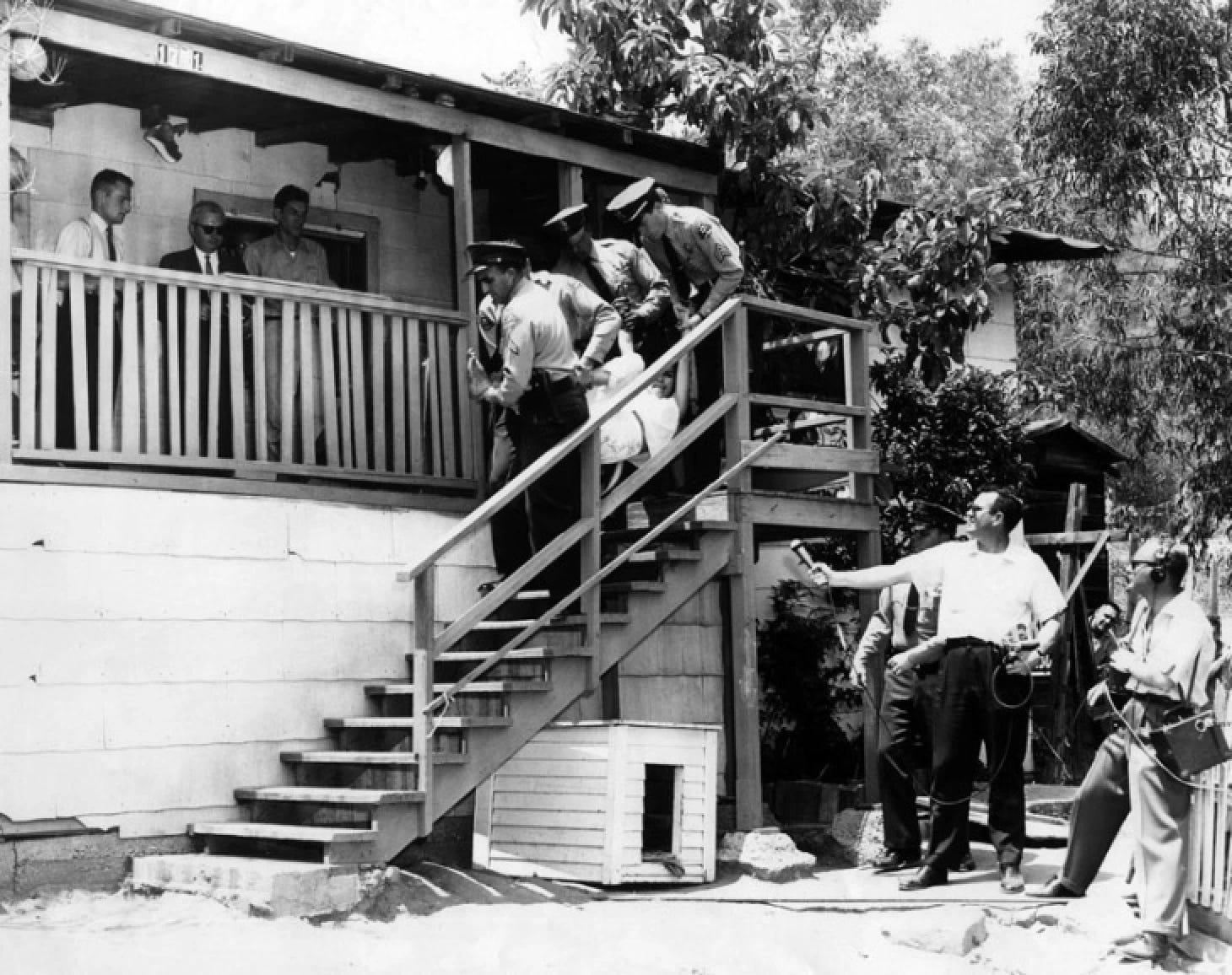
As with many communities primarily consisting of lower-income and non-white residents, the city of Los Angeles considered the Ravine a slum ripe for redevelopment. Under the guise of planning for a massive public housing development called Elysian Park Heights, the city pressured residents to sell their homes, often offering predatory cash payments but also resorting to threats, violence, and the strong arm of eminent domain. Those displaced were told they could take up residence in the projects. By 1953 most residents had left. It was the same year the Elysian Park Heights endeavor crumbled under the weight of new mayor Norris Poulson, who found public housing to be fundamentally unamerican and subsequently shuttered the project.
The city bought back the land despite 20 families still residing there, holding out in protest of the development, and soon sold it to Walter O’Malley as the grounds for the team’s new stadium. In 1959 the bulldozers arrived and the remaining residents were forcibly evicted. And in 1962, Dodger Stadium rang in its first-ever Opening Day.
O’Malley was a savvy guy, far savvier than most MLB team owners of the modern day. In moving the team from Brooklyn to LA he recognized that he’d have to work to build the club’s relationship to the community it now courted. For years this meant keeping an eye on the baseball leagues down south in Mexico. O’Malley craved a Mexican ace pitcher, recognizing that signing one to the Los Angeles Dodgers would mean winning over the city’s massive community of Mexican and Latin American immigrants. But he had his team keep an eye on all positions, figuring a solid infielder couldn’t hurt. In the late 1970s they sent scout Mike Brito down to get a look at a shortstop named Ali Uscganga. When Uscanga took the plate he got thrown three straight balls. The pitcher followed them up with three straight strikes. Brito’s eyes shifted from Uscanga and fell on El Toro.
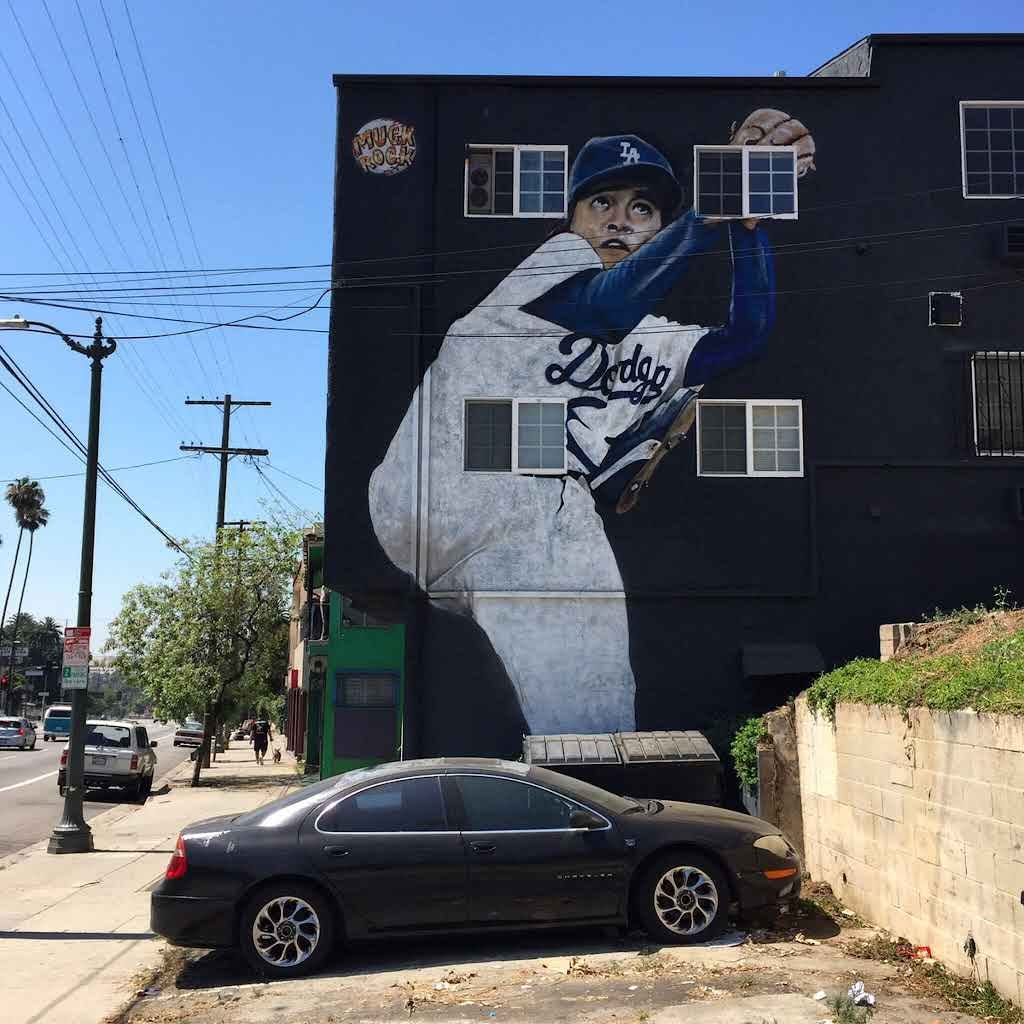
In 1979 Fernando Valenzuela joined the Los Angeles Dodgers through their minor league system and in 1980 he made his major league debut. In 1981 he shifted from relief pitcher to starter and that is when It Happened, when Fernandomania took over the city, when everything changed for the Los Angeles Dodgers. O’Malley had his Mexican ace and it did exactly what he thought it would–it won the Dodgers the city. It won them the nation, if we’re being real. Valenzuela was a crossover superstar the likes of which the team hadn’t seen since Jackie. In his first season as a starter he was invited to dine at the White House with the presidents of the United States AND Mexico. LeBron himself wasn’t received as well in his first season in the NBA.
If Fernando doesn’t happen the Dodgers aren’t what they are today, as a team or as an extension of Los Angeles. Valenzuela is why generations of immigrant families here fell in love with Dodger baseball and why members of those immigrant families passed the tradition down to their kids, kids of my generation, kids who grew up to be my closest friends and loved ones in this city. Fernando is where those childhoods mapped across the Chavez Ravine begin. My buddy Mike once said that if Fernando hadn’t happened, the clientele at Dodger Stadium would probably look a lot more like it does down in San Diego at Padres games. I’m glad it doesn’t.
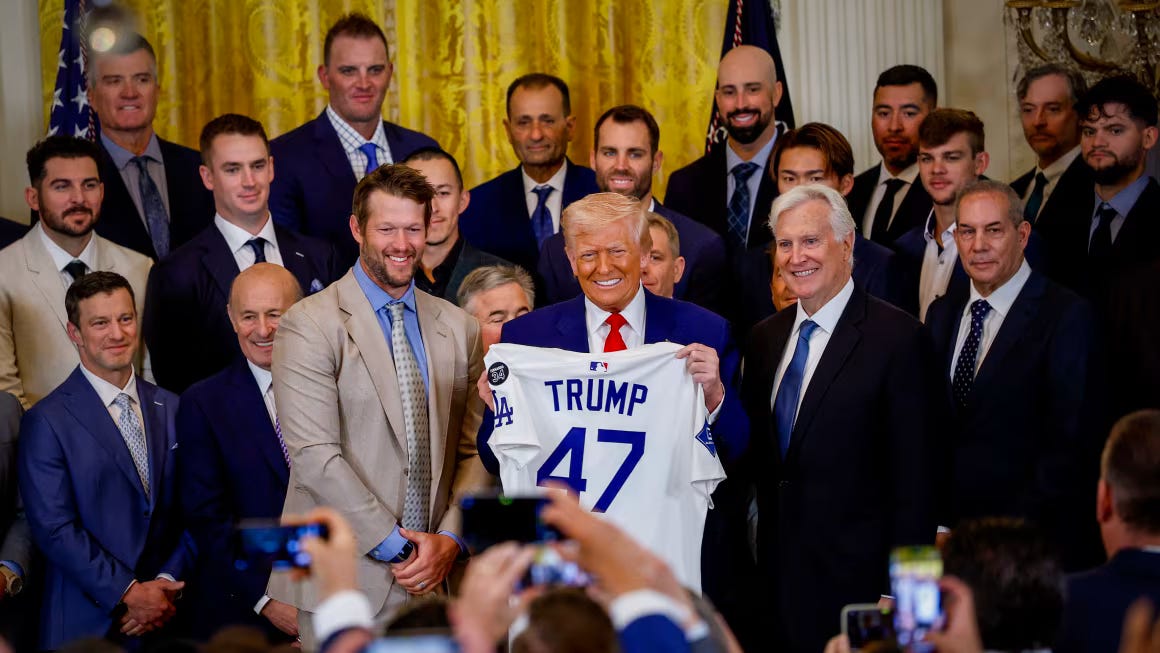
The shadow of June 2025 looms so large over the last year in Los Angeles that it’s easy to forget that the ICE raids began well before that. Trump’s rhetoric surrounding immigrant roundups in Los Angeles ramped up ahead of his second inauguration and the speed with which our neighbors began getting disappeared by a government agency was swift. Immigration crackdowns were in full force by February and most LA residents knew someone who knew someone who’d been subject to scrutiny from ICE (at best) by the time the Dodgers visited the White House. The team insisted it was a largely apolitical act when they presented Trump with a custom Dodgers jersey and posed for photos with him.
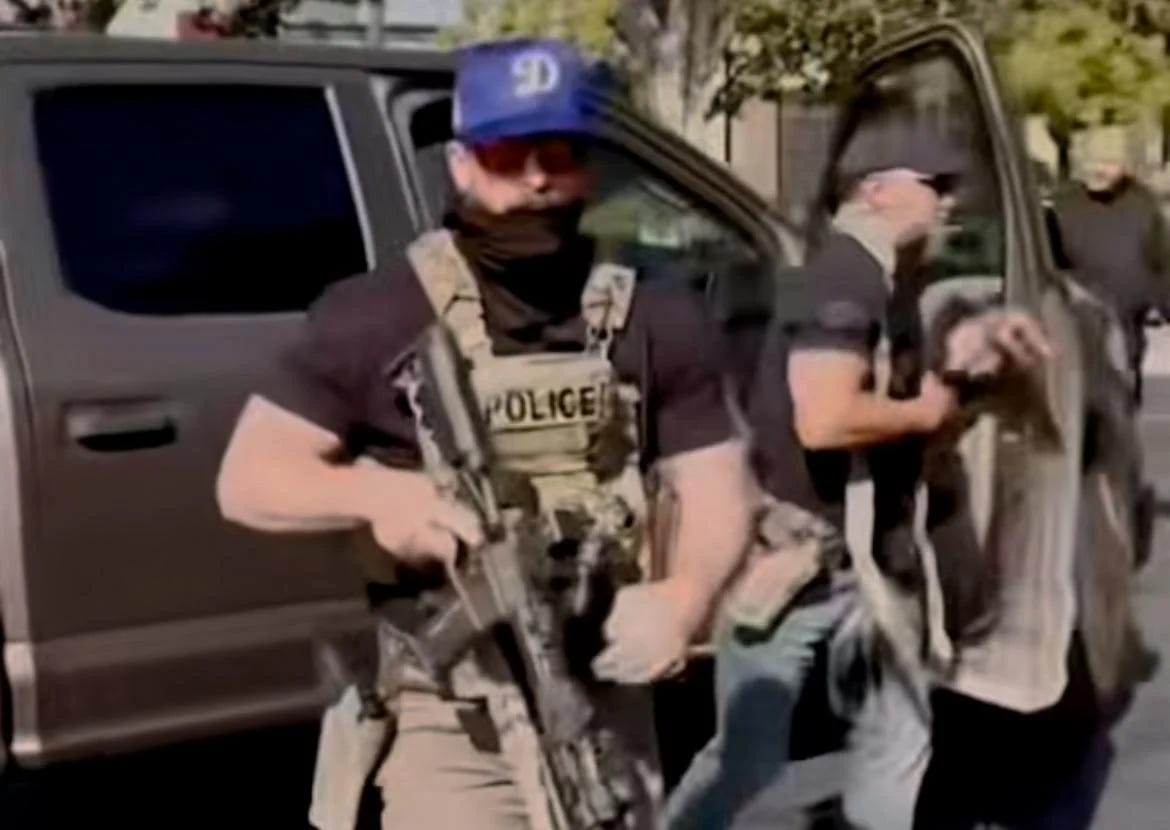
Still, there was a palpable change in June. That was when the roundups escalated, that was when the protests began, that was when it went from the normal kind of largely fascist immigration enforcement to the “vans of masked men abducting people in parking lots with zero explanation” kind of fascist immigration enforcement. The National Guard arrived later that month, stationing themselves just across the street from my old office building. The once-vacant parking lot I could spy from the window by my desk was soon full of humvees and tanks. During the raids ICE often has used (and continues to use) the parking lot by Dodger Stadium as a staging area. The parking lot is not owned by the team itself but if you ask me, if my neighbor hung a swastika flag from his window I’d be pretty quick to make some sort of public statement making it clear that it’s not my window that has the swastika flag and that I am personally not into swastika flags and that my apartment is a safe space for anyone who doesn’t fuck with swastikas.
The Dodgers didn’t do that. The Dodgers didn’t do anything, really–when asked about the raids, team manager Dave Roberts said he didn’t know enough about the topic to comment on it. The players individually remained silent as well, save for Kiké Hernandez who spoke out against the raids on Instagram. The stadium, for its part, removed attendees holding anti-ICE paraphernalia throughout the summer.
In 2012 the Guggenheim Baseball Group, headed up by Mark Walter, purchased the Dodgers from Frank McCourt for $2 billion. It’s under Walter that the team has become the modern juggernaut it is today. Walter spares no expense in developing players, chasing free agents, and providing the club with whatever it needs to entice free agents to suit up in blue. He is responsible for Mookie Betts, Freddie Freeman, Clayton Kershaw, Shohei Ohtani, Blake Snell, Tyler Glasnow, Yoshinobu Yamamoto, Roki Sasaki, and all other elite players that have passed through Dodger Stadium in the 13 years since he purchased the team.
At this point the Dodgers pay for themselves. They were already an immensely valuable franchise when Walter bought the team and have only become moreso since, especially after the Ohtani signing (a $700 million ten-year contract that had paid for itself at the end of Ohtani’s first year with the club). Dodgers fans are loyal and that means they will buy every jersey, every tee shirt, every specialty michelada, every hat, everything, period. They’ll pay increasingly ridiculous ticket prices. They’ll buy that $25 specialty cocktail.
Guggenheim Baseball Group is a subsidiary of Guggenheim Partners, which manages over $325 billion in assets. As CEO, Walter is in charge of managing those assets, about $12 million of which is invested in the GEO Group. The GEO Group is one of the most prominent private prison enterprises in the nation, an industry that blew up after the passing of the 13th Amendment in 1865. America is, after all, built on involuntary labor. Once forced servitude became illegal a workaround was necessary. Private prison populations have, as a result, been supercharged over the years thanks to Reagan’s orchestrated war on drugs as well as, more recently, increased immigration arrests. The GEO Group partners with ICE to operate the detention centers that now house countless Angelenos.
What a lot of people miss about the gold rush is that despite effectively building the United States’ economy in the west on its own, the money didn’t come from the gold itself. Sure, some prospectors got rich and the influx of gold was good for the economy. But the real money was in the rush itself, in supplies sold to the miners, in the towns that sprouted up and down the coast. It was in Levi Strauss denim and bars and hotels and gambling. Miners dragged their lives across the country in hopes of striking it rich and more often than not simply poured whatever money they did have into the burgeoning industry built on their backs. It’s a bit like if you had to travel all the way to New York to bet on the Knicks and then took up a lease so you could keep betting on the Knicks all season.
In 2024 on the back of strong merchandise sales and increased television revenue after the signing of Ohtani, the Los Angeles Dodgers became the first baseball team to reach $1 billion in revenue in a single season.
-
The gold rush ended in 1855. The land had been dragged bare, most easily accessible gold deposits discovered quickly and drained. The age of the independent miner had come to a close as well–whatever gold was left was being mined by hydraulic mechanisms digging deeper into the California dirt than any miner could manage or by larger conglomerates of miners who, rather than functioning as free agents, served as larger teams under corporate leadership. Still, no drill or miner team could compensate for the fact that the party was over. The gold was long gone. But America had arrived.
While indentured servitude was outlawed in 1965, The Act for the Government and Protection of Indians was not repealed until 1937. Between the peak of the gold rush and 1970 the population of Indigenous Californians residing in Los Angeles decreased from 3,693 to 219 people.
In 2019 Governor Newsom formally apologized for the Act for the Government and Protection of Indians.
Two weeks ago the Los Angeles Dodgers became the first back-to-back World Series champions in over twenty years. They did it over a seven game series that, in terms of the baseball itself, may go down as the best World Series of my lifetime. The 2024 win was a gutsy but dominant performance by a ballclub battered by injuries. The starting rotation of pitchers had been laid out, with only three (Jack Flaherty, Yamamoto, and Walker Buehler) healthy enough to pitch. Ohtani got injured during the series and the similarly injured Freeman’s MVP-winning performance came thanks to enough painkillers to tranquilize an elephant. It was a good win, a masterclass in scrappy October baseball.
This year’s win came by the skin of their teeth and almost entirely on the back of a generational pitching performance by Yamamoto. Playoff baseball is largely about luck and in two or three key moments it fell their way. The 2025 Dodgers made history and I am telling you, truly, I don’t think as many people care as last year. Throughout 2025 the Dodgers have been silent, save for the aforementioned IG post from Hernandez. They smiled politely through a visit to the White House that was transparent in its plans to target the city they represented. When those plans unfolded, with the assistance of the same man who signs their paychecks, they remained silent.
Maybe I expect too much of multimillionaire athletes but I think a team should serve as an extension of the city it represents. I think that the people who love a team, who pour their hearts and souls and wallets into it, deserve an organization and players who are willing to stand for them when it’s hard, not just when they’re atop a championship parade bus.
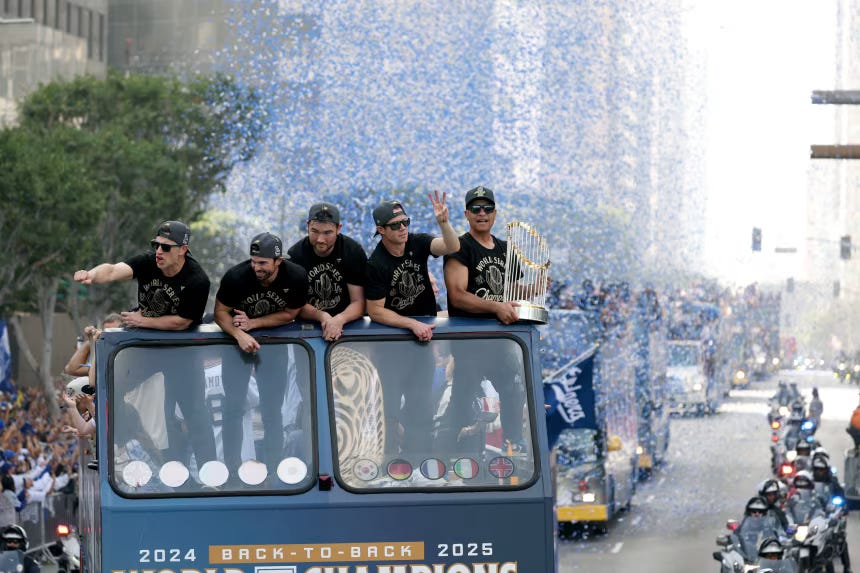
When the wildfires raged in January it was hard not to notice who did and didn’t come out to help. Personally, I’ve never seen LA’s community show up as hard as it did then. Still, there was a certain subset of Los Angeles transplant–you know the kind, the sort at whom most OverheardLA and AmericanaAtTheBrand memes are directed–who were nowhere to be found, just as they were nowhere to be found when the community stepped up to take direct action against ICE raids in June (well, some of them were to be found dining at DTLA bistros and watching in discomfort as marches passed them by). It’s a tale as old as time around these parts. For centuries now people have moved to the west coast in search of fortune or fame or followers. They don’t participate in community because they don’t see the city as a living, breathing organism. They see it as an opportunity.
People who live here will tell you that those transplants make up a minority of LA residents and they’re right, but the city often caters to them, which makes their influence disproportionately loud. Those coffee shops and vintage stores and organic wine bars, that’s who they’re for. Like mining towns in the mid-19th century, a neighborhood catering to that strain of temporary resident is a similarly temporary fixture in turn. The damage it wreaks is often more permanent. Once you’ve shut down a carniceria to turn it into a Mendocino Farms, it’s not coming back just because the Mendocino Farms closes four years later.
Dodger Stadium has become a preferred destination for near any player looking for a change of scenery in Major League Baseball. Every winter a new crop signs on and makes the trek to the coast. It’s no mystery as to why. The weather in Los Angeles is great, the front office has money to burn, there are investment opportunities abound, you’re in close proximity to Hollywood and the endorsement deals that come with it, and you get to contend for a championship every season. It’s the land of opportunity. There’s gold in them hills.
New stars sign on, often to some record-breaking contract or another. Tickets get more expensive. $30 specialty cocktails get added to the concessions menus and hot streetwear collaborators get in on the Dodger brand. You wouldn’t know it by the look of the packed stadium seats but some of the longest-tenured Dodger faithful are in the process of being priced out. That’s to say nothing of the over 3,000 Angelenos who have been abducted by immigration services over the last several months. I doubt Mookie and Shohei and Freddie can see the empty seats from the field.
A team can’t represent what it puts itself at an intentional remove from, and in 2025 the Dodgers have been incredibly clear about who they do and don’t represent. When they say they win their titles for the city I wonder which city they’re winning them for. It’s certainly not the one they’ve refused to acknowledge exists this year. Still, there’s another Los Angeles, another California, that these players and this team exist in the tradition of; one of fortune-seekers and bulldozers, one that sees the city as a convenience rather than a community. Where generations of Angelenos see a stadium that may as well be a church, they see a means to an end. To take is their nature. For us to expect anything in return is perhaps unrealistic. After all, they don’t really live here. They’re just passing through.
excellent writing